

How can I tell if I am in menopause?
The menopause does not begin suddenly but progresses over several years in different phases – usually starting from the mid-40s. Early signs can appear gradually and vary greatly from woman to woman. A typical sign is an irregular cycle: menstruation becomes shorter, longer, heavier, or temporarily stops altogether. Hormonal symptoms such as hot flashes, night sweats, sleep disorders, or mood swings often occur.
In addition, many women report:
-
Fatigue and Concentration Problems
-
Irritability or Depressive Moods
-
Vaginal Dryness and Loss of Libido
-
Joint Pain or Weight Gain
A common misconception: Not every woman experiences all symptoms – and not all symptoms necessarily indicate menopause. Nevertheless, age, cycle changes, and typical complaints are usually sufficient to medically classify menopause without a blood test. Your gynecologist or general practitioner can usually assess from your medical history whether you are in perimenopause. A blood test is only useful in unclear cases or if premature menopause is suspected.
From what age is menopause classified as “premature”?
menopause is then considered prematurely, when the function of the ovaries before the age of 40 permanently declines and no more ovulations occur. This condition is medically known as premature ovarian insufficiency (POI) or Klimakterium praecox referred to. Although it is a rare form of menopause, about one in 100 women affected – in about 0,3 % it even occurs before the age of 35 occur.
Typical Symptoms of premature menopause resemble those of the “classic” menopause:
-
Absence or Irregularity of Menstruation
-
Hot Flashes, Sleep Disorders, Mood Swings
-
Vaginal Dryness and Loss of Libido
-
Exhaustion, concentration problems, and depressive mood
The diagnosis is made by a Hormone examination – especially by determining the FSH value (follicle-stimulating hormone) and AMH value (Anti-Müllerian hormone), which provides information about the egg reserve. In premature estrogen deficiency, the risk of Osteoporosis and Cardiovascular diseases, which is why in these cases often a Hormone therapy until the natural menopausal age is recommended. An early medical consultation is therefore essential.
Which symptoms indicate the onset of menopause?
The menopause usually begins gradually – often with nonspecific complaints that are not immediately associated with hormonal changes. Many symptoms already occur in premenopause or perimenopause, that is, before the final cessation of menstruation. The following table provides an overview of common symptoms and their possible hormonal causes:
|
Symptom |
Description |
Possible hormonal cause |
|
Irregular menstruation |
Cycle shortening, lengthening, or spotting |
Drop in progesterone and estrogen |
|
Sudden hot flashes with sweating, especially at night |
Fluctuating estrogen levels, disturbed thermoregulation |
|
|
Difficulty falling and staying asleep, early awakening |
Estrogen and progesterone deficiency, melatonin deficiency |
|
|
Mood swings |
Irritability, depressive mood, inner restlessness |
Drop in sex hormones, influence on neurotransmitters |
|
Concentration problems |
Forgetfulness, mental exhaustion |
Hormonal influences on brain function |
|
Dryness, burning, pain during sex |
Decline in estrogen, mucous membrane atrophy |
|
|
Loss of libido |
Reduced sexual desire |
Estrogen and testosterone deficiency |
|
Stiffness, pain, especially in the morning or under strain |
Hormonal effects on tissue and pain processing |
|
|
Weight gain, especially around the abdomen |
Changed fat distribution type ("apple shape") |
Estrogen deficiency, increased testosterone effect |
|
Urinary tract complaints |
Frequent urge to urinate, overactive bladder, susceptibility to infections |
Mucous membrane changes due to estrogen deficiency |
Is a menopause test useful and reliable?
A menopause test – usually in the form of a Hormone blood tests – can be helpful in certain situations but is not necessary or meaningful in all cases. In women from 45 years old such a test is usually not necessary, as the diagnosis is based on typical symptoms, cycle changes and the Age can be made. In this age group, hormone levels fluctuate strongly anyway, so a single measurement often has little significance.
An elevated FSH value (>30 IU/L) can indicate the onset of menopause, but should be confirmed by determined again after 6 weeks exclude menopause not alone, especially in women with still active ovarian function.
Which blood values are crucial in a menopause test?
A blood test should always medically supervised should be performed, as interpretation depends on the individual cycle stage, age, medication intake (e.g., hormonal contraception), and symptoms.
-
FSH & estradiol are the most important markers for menopause diagnostics.
-
A single elevated FSH value is not conclusive – a second check after about 6 weeks is recommended.
-
AMH are particularly suitable for assessing premature menopause or when wishing to conceive.
-
Thyroid values such as TSH are important because thyroid diseases can cause similar complaints (e.g., fatigue, cycle disorders, hot flashes).
|
Laboratory value |
Meaning |
Indication of menopause |
|
FSH (Follicle-stimulating hormone) |
Controls egg maturation in the ovary |
↑ Significantly increased (>30 IU/L) with declining ovarian function |
|
LH (Luteinizing hormone) |
Supports ovulation and corpus luteum formation |
↑ Increased in perimenopause and postmenopause |
|
Estradiol (E2) |
Most important estrogen of the fertile years |
↓ Significantly reduced in menopause (<30 pg/ml typical) |
|
AMH (Anti-Müllerian hormone) |
Marker for the egg reserve in the ovary |
↓ Not detectable or greatly reduced with declining fertility |
|
TSH (Thyroid-stimulating hormone) |
Thyroid regulator, important for differentiation |
↑ or ↓ in thyroid dysfunction – symptoms can be similar |
|
Prolactin |
Influence on cycle and ovulation |
↑ Can cause cycle disorders, differential diagnosis |
When is a hormone test to determine menopause useful?
Menopause tests are not routinely necessarybut can be diagnostically helpful is always crucial. medical assessment the complaints in the overall context.
A hormone status is especially useful in the following cases:
-
In cases of Women under 40 years oldto clarify premature menopause (premature ovarian insufficiency)
-
In cases of unclear complaints, when it is not certain whether they are due to climacteric or other causes (e.g., thyroid disease)
-
In case of persistent Cycle loss under 45 years
-
To assess fertility or in Desire to have children
-
In individual cases for decision-making in Contraception in perimenopause
How reliable is a self-test for menopause at home?
Self-tests for menopause, which are freely available in stores or online, promise a quick assessment based on a urine test – usually by determining the FSH level (follicle-stimulating hormone). But as simple as these tests seem to use, their informative value is limited.
Especially in Perimenopause hormonal balance is subject to strong fluctuations. The FSH level can therefore vary from day to day – a single high measured value does not have to mean menopausethat menopause has begun. Likewise, a normal value does not cannot exclude, if ovarian function is still active.
-
Contraceptives (e.g., pill, hormonal IUD) influence hormone levels and make the test unreliable
-
An elevated FSH level can other causes as well have, for example due to stress, severe underweight, or after infections
-
The Evaluation is done without medical supervision, whereby important differential diagnostic clues (e.g., thyroid disease) remain undetected
According to German Pharmacists' Newspaper and Stiftung Warentest are menopause self-tests not be reliable enoughto make a clear statement about hormonal status. They can at most a first orientation offer, but no substitute for a medical diagnosis. A self-test at home may seem simple, but it is not a reliable indicator for the onset of menopause. Those suffering from typical symptoms or uncertain should seek thorough medical advice and, if necessary, a targeted blood test should be considered – especially in women under 45 or suspected of premature menopause.
Can hormone levels be within the normal range despite menopause?
Yes, especially in Perimenopause hormone levels fluctuate greatly. This can cause a a single measured FSH or estrogen level can be well within the normal range – even if the woman already has typical menopausal symptoms. A normal hormone level therefore does not exclude menopause, which is why medical diagnosis and symptom assessment are always more important than single measurements.
What role do thyroid values play in menopause diagnostics?
Thyroid values – especially the TSH level (thyroid-stimulating hormone) – play an important role in the evaluation of menopausal complaints because Thyroid diseases with similar symptoms can cause. These include:
-
fatigue and exhaustion
-
mood swings or depressive moods
-
weight gain or loss
-
cycle irregularities
Especially with unclear symptoms or in women under 45 years, a thyroid dysfunction (hypo- or hyperthyroidism) may be the cause – or coexist alongside menopause. A simple blood test of TSH valuepossibly supplemented by fT3 and fT4 valueshelps to establish this differential diagnosis. Thyroid values should always be checked as part of menopause diagnostics to avoid misdiagnoses and enable targeted treatment.
What to do in case of premature menopause – and which therapy helps?
Premature menopause – also known as premature ovarian insufficiency (POI) called – represent a special health and emotional challenge. Menopause occurs before the age of 40 affected women often suffer not only from typical climacteric symptoms but also from the psychological consequences of the unexpectedly early loss of fertility. This makes early diagnosis all the more important. early diagnosis and an individually tailored treatment.
|
Therapy option |
Goal |
|
Hormone therapy (HRT) |
Compensation for estrogen deficiency, protection against osteoporosis and cardiovascular diseases |
|
Local hormone therapy (e.g., vaginal suppositories with estrogen) |
Relief from vaginal dryness, burning, and susceptibility to infections |
|
Moisturizing, anti-inflammatory, and soothing treatment of vaginal complaints; accompanying relief of hot flashes, sleep disturbances, nervousness, and joint complaints – without systemic hormonal effects |
|
|
Herbal preparations & lifestyle |
Supplementary for mild symptoms or as an alternative in case of hormonal contraindications |
|
Psychological support |
Support for emotional distress, stress, and acceptance of premature life changes |
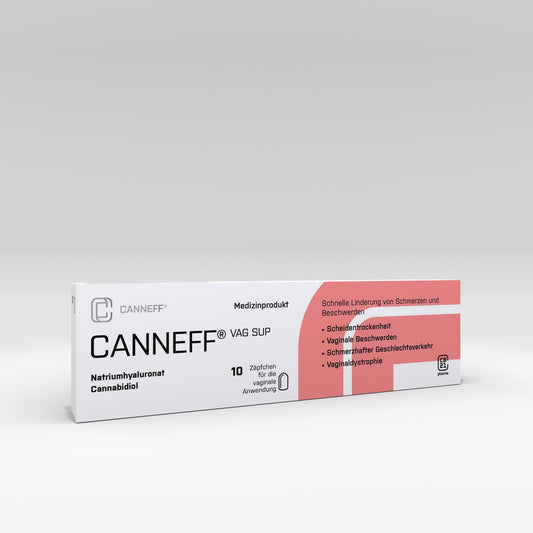
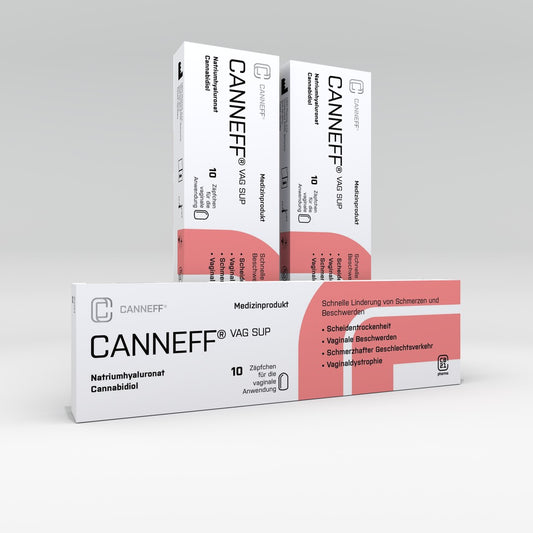
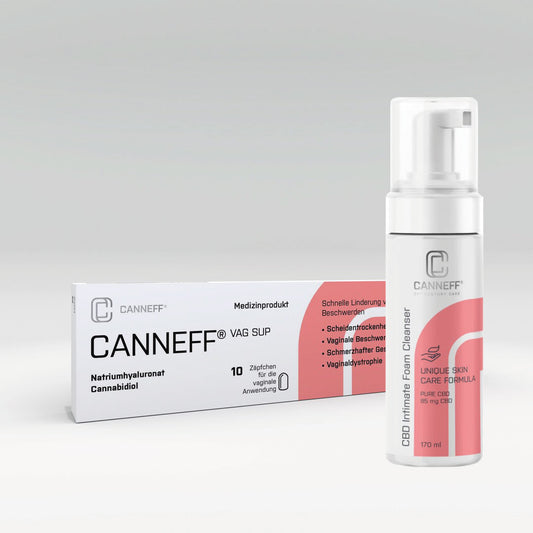
Women with premature menopause often suffer particularly intensely from typical climacteric complaints such as vaginal dryness, sleep disorders, hot flashes, or nervousness. In this phase of life, when systemic hormone therapy is not always desired or possible, they offer CANNEFF® VAG SUP vaginal suppositories an effective, well-tolerated, and hormone-free treatment option.
The suppositories combine high-molecular hyaluronic acid with cannabidiol (CBD) in a patented formulation. This combination intensely moisturizes the sensitive vaginal mucosa, promotes regeneration, and protects against irritation and microbial attacks. At the same time, CANNEFF unfolds its soothing, anti-inflammatory, and pain-relieving effectwhich can positively affect sleep quality, nervousness, and even joint complaints.
clinical studies confirm: Regular use of CANNEFF® suppositories for at least 30 days leads to a significant reduction of menopausal symptoms – including hot flashes, insomnia, depressive moods, and concentration problems – and measurably improve quality of life. Due to the local application the suppositories act precisely where symptoms occur, while remaining free from systemic side effects.
Especially for women with early menopause the CANNEFF® VAG SUP suppositories provide a safe, everyday-friendly, and clinically tested Offers a way to address the complaints of this challenging phase of life holistically and naturally.