

What does a feeling of pressure in the vagina mean in vaginal dryness?
A feeling of pressure in the vagina can be an early sign of vaginal dryness, indicating that the vaginal mucosa is no longer sufficiently moisturized and elastic. This uncomfortable sensation arises because the dry mucosa is more sensitive to mechanical stimuli such as friction or pressure. This feeling of pressure can be particularly noticeable when sitting, walking, or during sexual intercourse, leading to constant discomfort in the intimate area.
Is an unpleasant feeling of pressure a typical sign of vaginal dryness?
Yes, a feeling of pressure is one of the typical, though less well-known, symptoms of vaginal dryness. It occurs when the mucosa loses elasticity due to lack of moisture and can no longer withstand mechanical stress well. Combined with other complaints such as itching, burning, or pain during sex, it clearly indicates a disturbed vaginal environment.
What does vaginal dryness with a feeling of pressure feel like?
Affected individuals often describe the feeling of pressure as a constant internal tension, as if the vagina is slightly swollen or stretched from the inside. In many cases, this sensation occurs together with a diffuse soreness or sensitivity to tight clothing. Wearing underwear or inserting tampons can also feel pressing when vaginal dryness is present.
What distinguishes a feeling of pressure in vaginal dryness from other causes?
Unlike a feeling of pressure caused by vaginal prolapse, cysts, or tumors, the pressure sensation in vaginal dryness is usually not associated with visible changes in pelvic ultrasound or significant anatomical displacement. Instead, the sensation is based on a functional disorder of the vaginal mucosa. Due to estrogen deficiency, it loses thickness and lubricity, so even slight stretching stimuli are perceived as pressure.
What other symptoms occur in addition to the feeling of pressure?
The feeling of pressure often does not occur in isolation but in combination with other symptoms such as vaginal itching, burning, increased urge to urinate, or pain when urinating. Dyspareunia, meaning pain during sexual intercourse, as well as small mucosal tears with slight bleeding, are also typical parts of the symptom complex of vaginal dryness. The following comparison provides an overview of typical accompanying symptoms:
|
Symptom |
Relation to Vaginal Dryness |
|
Itching in the intimate area |
Very common, caused by mucosal irritation |
|
Burning and soreness |
Typical with dry and sensitive mucosa |
|
Feeling of pressure in the vagina |
Common additional symptom due to loss of elasticity |
|
Very common, caused by lack of lubrication |
|
|
Urge to urinate or overactive bladder |
Possible consequence of irritated bladder environment |
Can a feeling of pressure in the vagina indicate the onset of mucosal atrophy?
Yes, the sensation of pressure is an early warning sign of possible atrophic changes in the vaginal mucosa. Especially during the menopause or under antihormonal therapy (e.g., in breast cancer patients), increasing estrogen deficiency can lead to vaginal atrophy. This atrophy initially manifests as dryness and a feeling of pressure before pain or visible mucosal changes occur.
When does a feeling of pressure in the intimate area become a warning sign?
If the feeling of pressure intensifies, persists continuously, or occurs together with bleeding, discharge, or lower abdominal pain, a gynecological examination should definitely be carried out. Such symptoms can also indicate an infection, an organic cause, or pelvic organ prolapse that may require treatment.
How is the feeling of pressure related to estrogen deficiency?
Estrogen deficiency leads to regression of the vaginal mucosa and impaired blood flow. This makes the tissue less elastic and more susceptible to pressure and friction. Additionally, the natural production of vaginal fluid decreases, leading to increased dryness. The combination of reduced moisture and mucosal atrophy explains the close connection between the feeling of pressure and estrogen deficiency.
What gynecological findings are common in vaginal dryness with pressure?
Gynecologically, in cases of vaginal dryness with a feeling of pressure, a paler, smooth, or parchment-like mucosa and an elevated pH value are often observed. Swabs usually do not show an active infection but may indicate signs of dysbiosis of the vaginal flora or early atrophy. On gynecological palpation, the vagina may appear tender to pressure, shortened, or slightly fragile.
What helps against the unpleasant feeling of pressure in vaginal dryness?
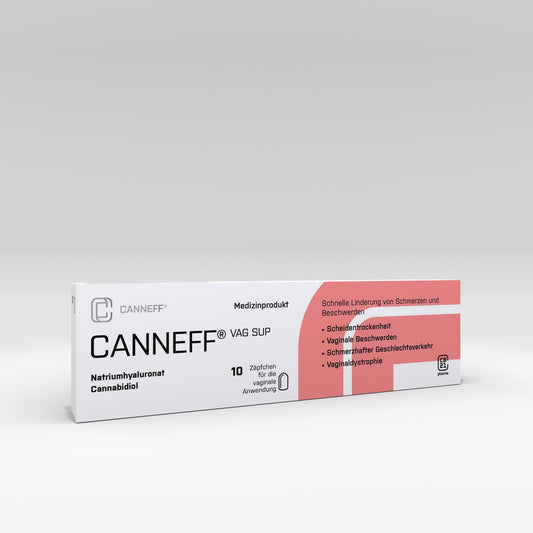
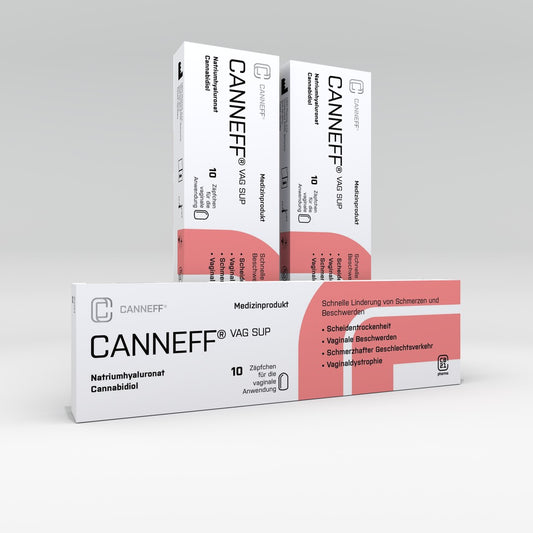
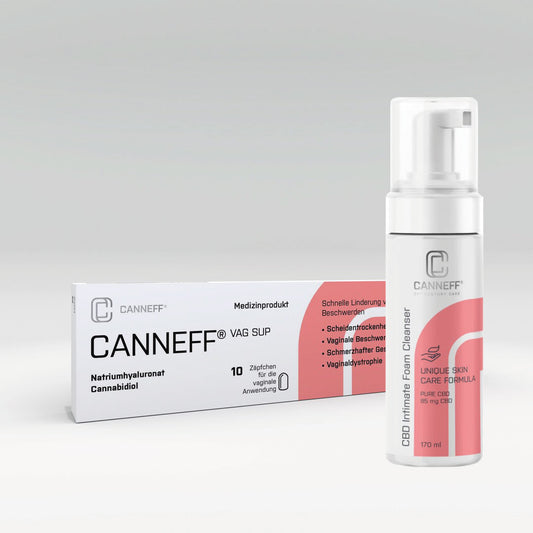
To relieve the feeling of pressure, targeted moisturizing and regeneration of the vaginal mucosa are crucial. Non-hormonal agents such as vaginal suppositories containing hyaluronic acid and cannabidiol (e.g., CANNEFF® VAG SUP) can help soothe the tissue, restore moisture, and strengthen the natural barrier function. In cases of pronounced estrogen deficiency, local estrogen therapy may also be considered. Avoiding irritating intimate products, switching to breathable underwear, and proper intimate care also play an important role in reducing the sensation of pressure.