

How can I tell if it is vaginitis or a yeast infection?
Both bacterial vaginitis (colpitis) and a yeast infection of the vagina (vaginal mycosis) can be accompanied by discharge, itching, and burning. The main difference lies in the type of discharge and the skin condition in the intimate area. While a bacterial infection often causes a thin, gray-white, unpleasant-smelling discharge, a vaginal yeast infection typically shows a whitish, crumbly, odorless discharge accompanied by intense itching. Additionally, yeast infections often cause the outer labia to be strongly reddened and swollen, which is less common in bacterial colpitis.
How do the symptoms differ between yeast infection and bacterial vaginosis?
A vaginal yeast infection usually causes strong itching, a Burning during urination as well as a clearly visible redness and swelling of the vulva. Bacterial vaginosis, on the other hand, is rather characterized by increased discharge with a fishy odor, without severe irritation of the external mucous membranes. Pain during sex can occur in both forms, but is more common with yeast infections due to mechanical friction, while in colpitis the mucous membrane overall reacts more sensitively.
|
Symptom |
Vaginal yeast infection |
Bacterial vaginosis (colpitis) |
|
Itching |
Severe, distressing |
Mild or absent |
|
Discharge |
White, crumbly, odorless |
Thin, gray-white, fishy odor |
|
Redness of the vulva |
Often pronounced |
Rather rare |
|
Burning during urination |
Often present |
Possible, usually mild |
|
Odor |
Neutral |
Fishy, sweetish |
|
Vaginal pH value |
Unchanged (acidic) |
Increased (alkaline) |
What color and consistency does the discharge have in a yeast infection compared to colpitis?
Vaginal discharge often provides the first clue to the underlying cause. In a yeast infection, the discharge is usually whitish, curd-like, or creamy, odorless, and difficult to wipe away. In bacterial vaginitis, however, the discharge appears gray-yellowish, thin, and often has an unpleasant smell. Additionally, discharge in a mixed infection can be foamy or greenish, especially with trichomonads.
Does the discharge smell different in a yeast infection than in bacterial vaginitis?
Yes, and this difference is clinically very relevant. Bacterial vaginosis is typically associated with a fishy, unpleasant odor that intensifies especially after sexual intercourse or during menstruation. Discharge from a vaginal yeast infection, on the other hand, usually remains neutral in smell. If an originally odorless discharge suddenly develops an unpleasant smell, this may indicate an additional bacterial infection.
What causes more itching – vaginal inflammation or yeast infection?
The most intense itching usually occurs with a yeast infection. The mucous membrane is not only irritated but reacts allergically to the yeast colonization, leading to severe scratching, burning, and in some cases even small cracks. In bacterial vaginosis, itching is rather rare or mild. If itching is prominent in colpitis, this may indicate a mixed infection or additional irritation from hygiene products.
How reliably can I tell myself whether I have a yeast infection or a bacterial infection?
Distinguishing between them is often not clear for laypeople, as some symptoms overlap. A typical yeast infection is usually easy to recognize when itching, redness, white coating, and odorless discharge occur together. In cases of atypical or mild symptoms, especially with altered pH values or unpleasant odor, a medical examination through microscopic smear or pH test is advisable. pH test strips are available in pharmacies and can provide clues about the type of infection.
What role does pH value play in distinguishing between colpitis and yeast infection?
The vaginal pH in healthy women is acidic (3.8–4.5). In bacterial vaginosis, the pH rises above 4.5 because the lactic acid bacteria are displaced. In yeast infections, the pH usually remains unchanged, which is an important diagnostic aid.
|
Type of infection |
Typical pH value |
|
Healthy vagina |
3,8 – 4,5 |
|
Bacterial vaginosis |
> 4.5 |
|
Vaginal yeast infection |
Unchanged (≤ 4.5) |
Can a bacterial vaginal infection occur simultaneously with a yeast infection?
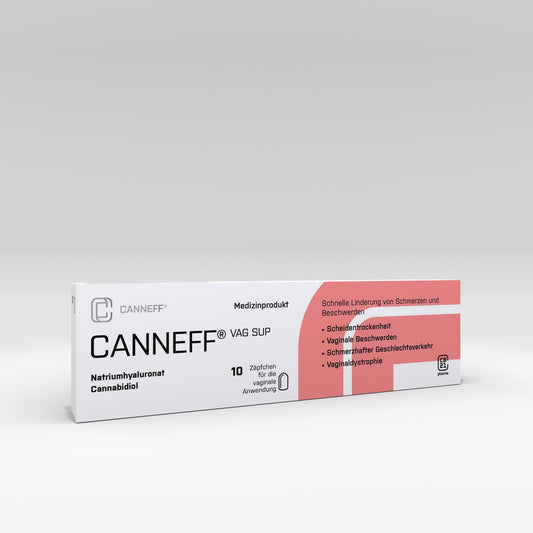
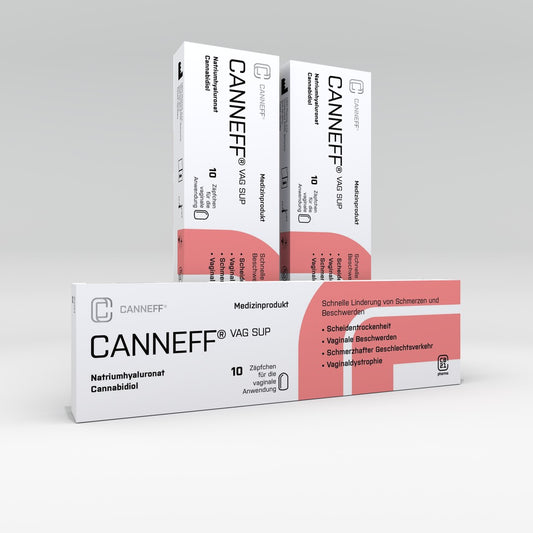
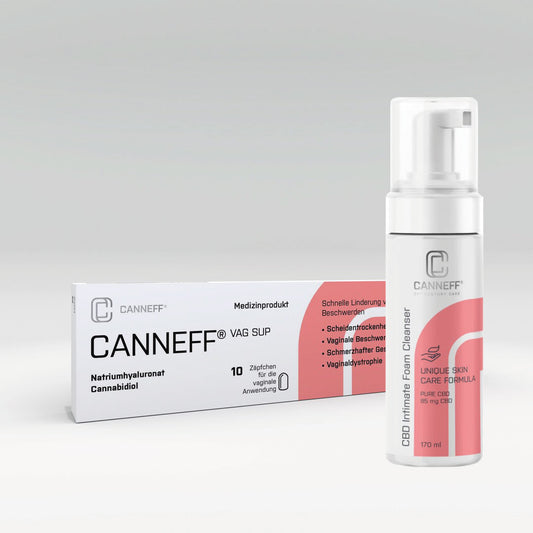
Yes, so-called mixed infections are not uncommon. Especially after antibiotic therapies or with disturbed vaginal flora, fungi and bacteria can settle simultaneously. Treatment then becomes more complex, as both an antifungal and an antibiotic or an antiseptic combination preparation may be necessary. In these cases, pH-regulating and regenerating products, such as CANNEFF® suppositories with CBD and hyaluronic acid, should also be used for mucous membrane care and flora stabilization, especially if vaginal dryness occurs during and after treatment.
Which treatment helps with yeast infections—and which with bacterial infections?
For a vaginal yeast infection, local antifungals such as clotrimazole or miconazole are used—usually as suppositories or cream. For a bacterial infection, metronidazole or clindamycin are preferred, sometimes as vaginal gel or tablets. Additionally, the use of lactic acid preparations can be helpful to restore the acidic environment.
When should I definitely see a gynecologist for unclear symptoms?
A doctor's visit is always recommended if symptoms persist for more than three days, recur, worsen, or if fever, bleeding, or pain occur. A gynecological examination should also be sought during pregnancy, at the first occurrence, or if self-treatment does not lead to improvement.