

What is non-bacterial prostatitis (chronic pelvic pain syndrome)?
While bacterial prostate infections are well treatable with antibiotics, the treatment of non-bacterial prostatitis, also known as chronic pelvic pain syndrome (CPPS), is significantly more challenging. If bacteria as the cause of the inflammation have been ruled out by the urologist, antibiotic treatment is generally not a commonly chosen approach. The condition of non-bacterial prostatitis is usually considered rather diffuse, symptoms are often persistent, and the exact cause of the inflammation is often unclear. Accordingly, the treatment of non-bacterial prostatitis or chronic pelvic pain syndrome should be individually coordinated with the treating physician.
Prostatitis is not just prostatitis. The symptoms of non-bacterial prostatitis are diverse and can cause men discomfort when urinating or during ejaculation. Depending on whether bacteria or other causes are behind it, urologists have various treatment options to choose from. It is clear that prostatitis should not be self-diagnosed or self-treated, but rather diagnosed and treated by a specialist. This way, the exact cause of prostatitis can be determined, and other serious diseases and differential diagnoses, such as prostate cancer, are not overlooked and left untreated. Any self-treatment of prostatitis should only be carried out by those affected after the exact cause and symptoms have been clarified by a specialist. Regular, often semi-annual check-ups with the specialist are urgently required for the symptoms of chronic non-bacterial prostatitis. Many patients regularly visit the urologist for PSA testing, digital rectal exams, ultrasound, or even an MRI if PSA levels are very high.
The symptoms of pelvic pain syndrome (abacterial prostatitis) persist in many affected individuals for weeks or even months – the condition becomes chronic and is referred to as CPPS (Chronic Pelvic Pain Syndrome). Chronic prostatitis then represents a real burden and limitation for those affected. However, those who better understand the causes, the clinical picture, and treatment options can actively contribute to the successful treatment of the non-bacterial form of prostate inflammation. Learn here how suppositories can help relieve certain prostatitis symptoms and thus make your daily life easier.
What are suppositories for the treatment of non-bacterial prostatitis?
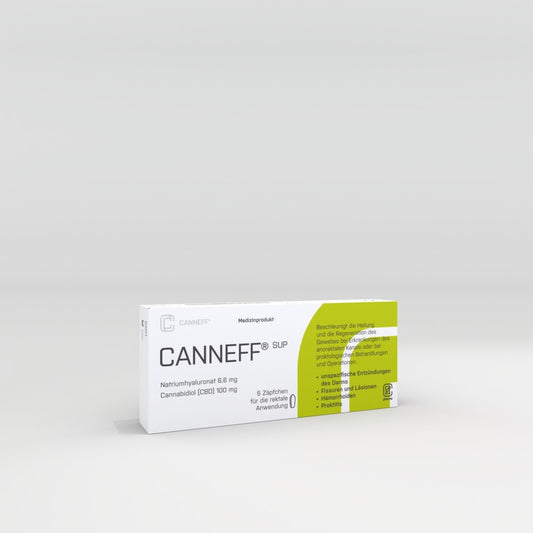
Certain suppositories are considered a proven therapeutic approach to relieve symptoms associated with non-bacterial prostatitis. Suppositories like Prosturol® or CANNEFF® SUP act directly in the affected area and can support tissue regeneration and alleviate certain symptoms of abacterial prostatitis, thereby improving the quality of life for those affected. In any case, consult a doctor to find and initiate the best possible treatment for the symptoms of non-bacterial prostatitis as well as effective pain reduction for prostatitis tailored to your individual situation and medical history.
In a pilot study with 16 patients suffering from chronic non-bacterial prostatitis/chronic pelvic pain syndrome (CP/CPPS), the CANNEFF® SUP CBD suppositories showed promising symptom relief.
CANNEFF® SUP demonstrated a clinically significant relief of symptoms of non-bacterial prostatitis after 30 days of use, comparable to systemic treatments such as alpha-blockers, phytotherapeutics, and NSAIDs, while offering a localized, non-systemic approach. These results highlight the need for a larger, controlled study to validate its effectiveness.
The CANNEFF® SUP CBD suppositories are also used for the treatment of hemorrhoids, anal fissures, anal fistulas, anal abscesses, proctitis, and other nonspecific intestinal inflammations, offering great potential through local rectal application to also relieve symptoms of non-bacterial prostatitis.
The active ingredients hyaluronic acid and CBD in CANNEFF® SUP suppositories aim to reduce inflammation and relieve discomfort, providing affected men with noticeable relief and an improvement in their quality of life. Additionally, the CANNEFF® SUP suppositories feature a unique and patented active ingredient matrix that delivers up to 5 times more hyaluronic acid compared to conventional hyaluronic acid suppositories on the market. Read more here about the effects and medical applications of CBD.

CANNEFF® SUP suppositories are characterized by a combination of hyaluronic acid and medical CBD (cannabidiol). This patented emulsion matrix with the combination of active ingredients plays an important role in modulating inflammatory processes and has a cell-protective effect. Hyaluronic acid, a natural polysaccharide in the human body, plays a crucial role in regulating moisture in the skin and connective tissue. It can bind enormous amounts of water, thereby supporting the stability and elasticity of tissues and mucous membranes. This unique combination of active ingredients in the CANNEFF® SUP suppositories shows a synergistic effect. The medical CBD optimizes the environment for the effect of hyaluronic acid, while hyaluronic acid maintains the moisture of the mucous membrane, thus supporting healing and pain relief in the rectal area and the anogenital region. Read more here about the unique combination of hyaluronic acid and CBD.
Which suppositories for non-bacterial prostatitis?
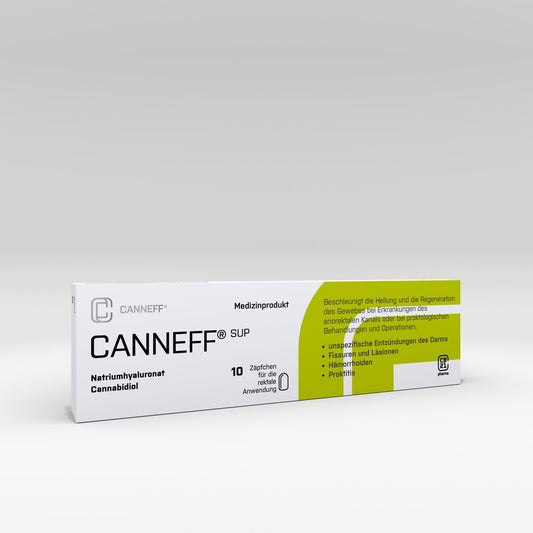
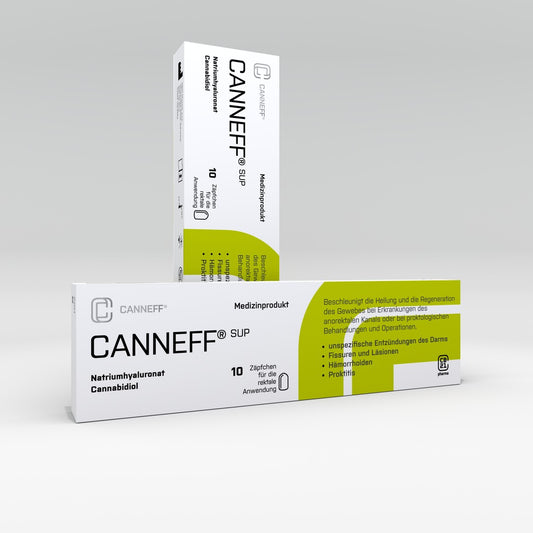
CANNEFF® SUP suppositories are an innovative medical product that contains not only hyaluronic acid but also medical CBD (cannabidiol). CANNEFF® SUP rectal suppositories can relieve symptoms of non-bacterial prostatitis as well as a range of other proctological conditions up to nonspecific inflammations in the rectum. These rectally applied suppositories contain a unique combination of hyaluronic acid and CBD, which can contribute to faster regeneration and healing of the surrounding tissue.
Pain from the prostate often radiates into surrounding tissues such as the rectum, seminal vesicles, vas deferens, and bladder. The surrounding connective tissue is also often affected by inflammation. This tissue supports and stabilizes the organs but also serves other functions in the body, such as protecting against pathogens and supplying nutrients. A very important component of connective tissue is hyaluronic acid, which primarily has a water-binding property. In the context of therapy for prostatitis or chronic pelvic pain syndrome, supplying hyaluronic acid can increase the elasticity of the connective tissue in the painful areas near the prostate and anal canal. The tissue structure can also normalize and relax, thereby helping to calm the nerve plexus in the affected area. This may also reduce the painful pressure and tension sensation. Depending on the course of treatment, sustainable regeneration of the tissue and symptoms may also occur. Because of these properties, hyaluronic acid is also used in prostatitis therapy. Your treating physician can provide you with comprehensive information about various treatment options for non-bacterial prostatitis.
The measures you take to relieve the symptoms of non-bacterial prostatitis—whether regular exercise, a balanced diet, or stress reduction—are a very individual matter. Supportive, symptomatic adjunct therapy with suppositories like CANNEFF® SUP can provide local relaxation of the irritations and thus contribute to alleviating the symptoms of non-bacterial prostatitis.
How do CANNEFF® SUP suppositories work for non-bacterial prostatitis?
The focus is on the tissue-relaxing properties of hyaluronic acid, supported by medical CBD (cannabidiol), which together, according to a conducted pilot study, can also contribute to an improvement of symptoms in non-bacterial prostatitis. Due to the local application, CANNEFF® SUP suppositories can exert their effect directly through the anal canal, at the site of the inflammation. With the unique composition, the CBD suppositories can contribute to the local relaxation of stimuli, which is perceived as relief of symptoms associated with non-bacterial prostatitis or chronic pelvic pain syndrome. The active ingredients hyaluronic acid and CBD in CANNEFF® SUP suppositories aim to reduce inflammation and relieve symptoms, which can provide affected men with noticeable relief and thus regain their quality of life.
What advantages do suppositories offer in the treatment of non-bacterial prostatitis?
The administration as suppositories may initially be unfamiliar to some affected individuals, but it has great advantages. Thanks to the suppository form, CANNEFF® SUP can exert its effect directly at the site of the inflammation, through the anorectal canal. The ingredients are released without taking the detour through the gastrointestinal tract. This allows targeted relief of symptoms in non-bacterial prostatitis.
Suppositories generally act faster because the mucous membranes and surrounding tissues can quickly and effectively absorb the active ingredient matrix. Some suppositories, such as CANNEFF® SUP rectal suppositories, support the regeneration of damaged or inflamed tissue in the anal canal. Suppositories are also considered a good alternative to tablets and capsules, especially if you have difficulty swallowing larger tablets. They can be easily administered even when your general condition is reduced. In cases of nausea or vomiting, they are a good choice because the active ingredient enters the body directly and no side effects occur in the digestive tract.
How do suppositories differ from other treatments for chronic pelvic pain syndrome (non-bacterial prostatitis)?
Compared to other treatments for non-bacterial prostatitis or CPPS, suppositories offer several significant advantages. The greatest benefit of suppositories lies in their direct effect on the affected tissue. Suppositories are inserted directly into the anus, allowing the active ingredients to work directly in the affected area. This method ensures a steady release of the active ingredients over a longer period. The treatment plan for chronic pelvic pain syndrome is individually tailored and includes measures for stress reduction and symptom relief through medication. Your treating urologist will provide guidance throughout all measures. Various home remedies, nutrition, and targeted pelvic floor exercises can also be used to activate self-healing powers. Often, a holistic approach combining different measures is an effective way to manage the condition. Medical care and ongoing monitoring during the treatment of chronic pelvic pain syndrome are of central importance. Be sure to discuss various treatment options with your doctor. Your doctor can also advise you on additional measures.
How do I properly use suppositories to treat non-bacterial prostatitis?
Inserting rectal suppositories is a quick and completely painless procedure. For many men, it may only require a bit of courage. The use of suppositories for relief Recognizing the symptoms of non-bacterial prostatitis and other inflammations in the rectum is straightforward but still requires a certain level of care. The following explanation will guide you step by step in using the CANNEFF® SUP suppositories.
For hygienic reasons, it is recommended to wash your hands before and after inserting the CANNEFF® SUP suppository to prevent bacteria or other germs from entering the rectum during insertion. Wash your hands thoroughly and carefully with soap and warm water. Dry your hands thoroughly with a towel.
Therefore, separate a suppository at the perforated spot on the strip. Tear open the packaging by gently pulling it apart and carefully remove the suppository. Insert the suppository, in a comfortable position, with the rounded end first into the rectum. Many patients prefer to insert the suppository lying on their side with bent legs. However, you can also choose another position that is comfortable for you. Gently insert the suppository into the anal canal with the rounded end first. Be careful not to insert the suppository too deeply, only up to the internal sphincter muscle. Hold the position for a few minutes so that the suppository stays in place and can fully dissolve.
Sharing suppositories is not recommended. The suppositories do not have break lines. Improper handling can cause the suppositories to break, which may lead to contamination. After inserting the suppository, you should wash your hands thoroughly again to remove any residues of bacteria or germs from the anal area.
When using suppositories as part of the treatment, be sure to follow your doctor's instructions or the recommendations on the packaging or leaflet exactly. Do not exceed the recommended dosage of CANNEFF® SUP. If you have further questions about the application, it is best to consult your doctor or pharmacist.
What alternatives to CBD suppositories are there for the treatment of non-bacterial prostatitis?
Chronic non-bacterial (abacterial) prostatitis is unfortunately very persistent in many cases. There is no general therapy for all patients. For this reason, newer approaches focus on an individual and holistic treatment of prostatitis. In about 90 percent of cases, bacteria are not the cause of the prostate inflammation. The treatment of prostatitis generally does not rely on antibiotics but must consist of other therapeutic measures and medications. Sometimes, antibiotic therapy leads to treatment success even without evidence of bacterial pathogens. However, the trial use of antibiotics in non-bacterial prostatitis is considered controversial due to possible side effects.
For the treatment of non-bacterial prostatitis, there are various alternatives to suppositories. Pain relievers and anti-inflammatory drugs can alleviate pain, while alpha-blockers relax the muscles of the prostate and thus reduce urinary tract symptoms. Herbal preparations, such as pumpkin seed extract, can provide anti-inflammatory support. Heat applications, like sitz baths, promote relaxation of the pelvic muscles and relieve pain. Physiotherapy with special pelvic floor training and stress management also help, as stress often worsens symptoms. A balanced and wholesome diet can also be helpful. Thus, there are many treatment methods for prostatitis that go beyond medication and are often integrated into a holistic therapy.
Physical treatments like heat therapy – such as sauna, steam bath, infrared, or ultrasound therapy – improve blood circulation and can support the healing process. Microwave therapy, which warms the pelvic area with electromagnetic waves, is also used as an alternative prostatitis treatment. Additionally, you can use biofeedback training to better manage stress, and acupuncture as a traditional Chinese method can relieve prostate symptoms. A healthy, balanced diet, especially with foods like pumpkin seeds, oats, tomatoes, and psyllium, is also beneficial.
Additionally, adequate fluid intake, ideally two liters of water daily, supports the body in healing. Home remedies such as nettle or willow herb tea are also considered supportive.
Prolonged sitting can worsen the symptoms of prostatitis. Therefore, physical activity is also important, and activities such as light jogging and targeted pelvic floor exercises can help reduce symptoms. A doctor or physiotherapist can recommend suitable exercises. In certain cases, a prostate massage by a doctor can relieve the prostate and promote the drainage of inflammation-promoting substances.
What experiences are there with the use of suppositories for the treatment of abacterial prostatitis and chronic pelvic pain syndrome?
Patient testimonials regarding the use of suppositories to relieve the symptoms of non-bacterial prostatitis are positive. In a pilot study, the CANNEFF® SUP CBD suppositories showed promising relief of symptoms of non-bacterial prostate inflammation. The CANNEFF® SUP suppositories, which are also used for the treatment of used for certain proctological diseases as well as nonspecific inflammations of the intestine, they offer great potential to also relieve the symptoms of non-bacterial prostatitis due to their local, rectal application. Some patients already report an improvement in their symptoms. Therefore, do not let the symptoms of non-bacterial prostatitis continue to limit your daily life or sexuality. The testimonials for CANNEFF® suppositories for the treatment of abacterial prostatitis demonstrate that CANNEFF® SUP rectal suppositories offer a treatment option to relieve the symptoms of abacterial prostatitis.
How should I properly store suppositories for the treatment of non-bacterial prostatitis?
You should store CANNEFF® SUP rectal suppositories in their original packaging at room temperature, protected from sunlight, between 2°C and 25°C. Also, keep the suppositories out of reach of children. High temperatures can cause the suppositories to melt. If this occurs during hot summer temperatures, you can store the suppositories in the refrigerator during these periods. The shelf life of the suppositories is 2 years from production; the expiration date is indicated on the outside of the medical product packaging.
What should be considered when dosing suppositories for the treatment of non-bacterial prostatitis?
To support the relief of symptoms of non-bacterial prostatitis, apply 1 suppository daily before bedtime for 25 - 30 days. Your doctor will provide you with more detailed information. The duration of use depends on the development of the treated condition. However, the duration of use should not exceed 30 days. Here you can find further information on the dosage of CANNEFF® SUP rectal suppositories.
How long does it take for the suppositories to take effect?
The effect of suppositories usually begins after 15 to 60 minutes. However, the long-term healing of the tissue mainly depends on the severity of the prostate inflammation. Therefore, it may also be advisable to combine different treatment options for non-bacterial prostatitis. However, always consult your treating doctor to rule out any interactions.
Can I combine suppositories with other treatments for non-bacterial prostatitis?
Your doctor can recommend CANNEFF® SUP rectal suppositories as a supportive treatment for anorectal diseases, including to relieve symptoms of non-bacterial prostatitis, and can also combine them with other therapeutic approaches.
However, you should always consider combining medications, drugs, medical devices, as well as home remedies and other therapy options for the treatment of non-bacterial prostatitis only after consulting your doctor or specialist. This way, you can ensure that there are no unwanted interactions or side effects from the chosen treatment.
Are suppositories for the treatment of non-bacterial prostatitis available over the counter in pharmacies?
In the pharmacy, you will find both prescription suppositories and over-the-counter, freely available medical devices for the treatment of non-bacterial prostatitis. In Austria, CANNEFF® SUP suppositories are available without a prescription and can be ordered directly from the webshop.
In Germany, a prescription and pharmacy requirement applies because CANNEFF® SUP rectal suppositories, as a Class 2a medical device, also contain medical CBD (cannabidiol). In Germany, the suppositories are thus considered prescription medical devices, and your general practitioner or specialist must therefore CANNEFF® SUP suppositories in Germany Prescribed by prescription. Therefore, you can only order CANNEFF® SUP suppositories with a prescription through your pharmacy in Germany.