

What does it mean to tie off hemorrhoids?
Tying off hemorrhoids is a medical method for the treatment of enlarged hemorrhoids. The blood supply to the hemorrhoids is interrupted so that the tissue dies and is rejected by the body after a few days. The most common method is rubber band ligation, where small rubber bands are placed around the affected tissue.
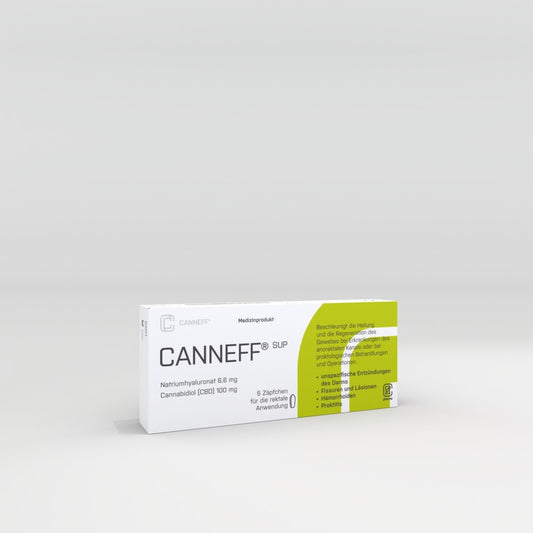
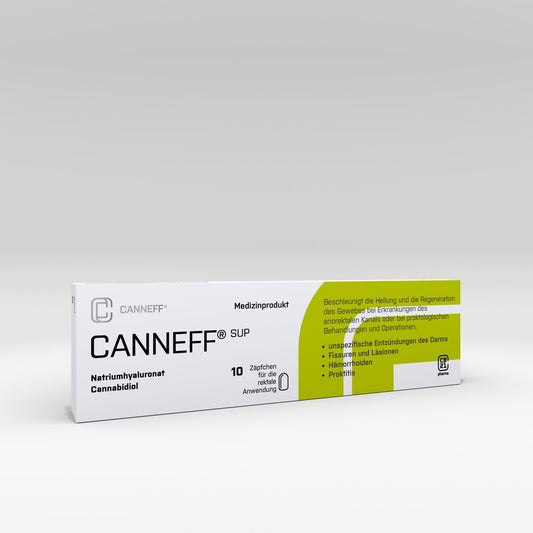
This treatment is especially suitable for hemorrhoids of the second and third degree, as they no longer regress on their own but do not yet require surgical removal. In some cases, rubber band ligation can be combined with other methods, such as anti-inflammatory preparations like CANNEFF® suppositories.
Is tying off hemorrhoids a safe method?
Yes, rubber band ligation is a safe and proven method for treating hemorrhoids. Since it does not involve cuts or surgical procedures, it is particularly gentle and carries few risks. However, it is not suitable for all patients – especially people with blood clotting disorders or acute inflammation in the anal area should discuss alternatives with their doctor.
How does rubber band ligation work against hemorrhoids?
In rubber band ligation, the hemorrhoid is tied off with a small rubber band so that no blood flows into the tissue. This causes the hemorrhoid to die within seven to ten days and be expelled with the stool. The procedure takes place in several steps:
Pre-examination: The doctor performs a Proctoscopy to determine the size and location of the hemorrhoids.
Fixation: The hemorrhoid is suctioned or mechanically grasped with a special instrument.
Rubber band ligation: A small rubber band is placed around the base of the hemorrhoid.
Death of the hemorrhoid: After a few days, the tissue falls off on its own.
After treatment, patients should focus on a high-fiber diet and adequate fluid intake to avoid constipation.
Is tying off hemorrhoids painful?
The procedure itself is hardly painful because the tissue of the hemorrhoids contains few pain receptors. However, after treatment, a slight pressure or foreign body sensation may occur, which can last for several hours to days.
Some patients experience mild cramps or discomfort during bowel movements. These symptoms are usually mild and subside within a few days. Painkillers or anti-inflammatory suppositories like CANNEFF® SUP can help relieve any discomfort.
How long does it take for tied-off hemorrhoids to fall off?
It usually takes seven to ten days for the hemorrhoid to die off and be expelled with the stool. Some patients do not notice the hemorrhoid falling off, while others observe slight bleeding or mucus discharge. These are harmless and disappear after a short time.
During this phase, hard stools and straining should be avoided to prevent irritation.
What risks are associated with rubber band ligation?
Although the method is considered safe, there are some possible side effects:
|
Possible side effect |
Description |
|
Mild bleeding |
After the hemorrhoid falls off, small bleedings may occur. |
|
Pain or pressure sensation |
Some patients report an uncomfortable sensation in the anal area. |
|
Thrombosis or infections |
In rare cases, a blood clot (anal thrombosis) can form. |
|
Insufficient effect |
Sometimes multiple sessions are needed to completely remove the hemorrhoids. |
If severe pain, persistent bleeding, or fever occur after treatment, medical evaluation is necessary.
Can hemorrhoids be tied off by oneself?
No, independently tying off hemorrhoids is not a safe method and can have serious consequences. Improper ligation can lead to:
-
severe bleeding, if the tissue is not properly separated
-
infections, as bacteria can enter the wound
-
severe pain, if the rubber band is too tight or placed in the wrong spot
Therefore, the treatment should always be performed by a specialist.
What alternatives are there to rubber band ligation?
If rubber band ligation is not an option, there are various alternative methods for treating hemorrhoids:
|
Alternative method |
Description |
|
Sclerotherapy |
Sclerotherapy of hemorrhoids by injection of a special solution. |
|
Infrared coagulation |
Heat treatment to shrink hemorrhoids. |
|
HAL-RAR method |
Vascular ligation by ultrasound. |
|
Ointments and suppositories |
Relief of symptoms, but no cure. |
Also, herbal remedies such as witch hazel or horse chestnut can be used as supportive treatments.
How effective is hemorrhoid ligation?
Rubber band ligation has a high success rate of 80-90%. However, the treatment may need to be repeated, especially if multiple hemorrhoids are present or the symptoms have persisted for a longer period. Successful treatment can be supported by dietary adjustments and healthy digestion.
When is a medical check-up necessary after ligation?
After the treatment, it is advisable to have a follow-up check within two to four weeks. A doctor visit is urgently required if:
-
severe bleeding appear
-
persistent pain or fever occur
-
if the symptoms do not improve after a few weeks
The ligation of hemorrhoids using rubber band ligation is an effective and gentle method to remove enlarged hemorrhoids. The treatment is minimally invasive, low-pain, and associated with a high success rate. It is important not to perform the method yourself but always have it done by a doctor. Preventive measures such as a high-fiber diet, plenty of fluids, and healthy bowel hygiene can reduce the risk of recurring hemorrhoids.